Sacred Knowledge Repository
पवित्र ज्ञान भंडार
Authentic Sources
All content sourced from original Vedas, Puranas, and Itihasas with proper scriptural references.
- Rigveda & Other Vedic Texts
- 18 Major Puranas
- Upanishads & Tantras
Multi-Script Access
Sanskrit integrity preserved across multiple scripts and translations.
- Devanagari Script
- IAST Transliteration
- English, Hindi, and Marathi Translations
Significance & Practice
Every stotra comes with its meaning, benefits, and step-by-step recitation guidance.
- महत्त्व (Significance)
- लाभ (Benefits)
- पाठ विधि (Recitation Vidhi)
Sacred Collections
पवित्र संग्रह
Stotram
7स्तुति गान
Sacred hymns of praise and devotion
Stuti
8भक्ति प्रार्थनाएँ
Devotional prayers and eulogies
Kavach
4रक्षा मंत्र
Protective mantras and armor prayers
Namavali
3नामावली
Collections of divine names
Suktam
2वैदिक सूक्त
Vedic hymns and sacred verses
Vidhi
3पूजा विधि
Ritual procedures and worship methods
Who is Lord Brahma?
ब्रह्मा कौन हैं?
Brahma is Srishti-kartā, the Creator - the first of the Trimurti, self-born as Hiranyagarbha, the Golden Womb of the Rigveda, and revered in the Vedas and Puranas as Prajāpati, the progenitor from whom the four Vedas, the sages, and all creation arose.
Across the Ramayana, Mahabharata, and the Puranas he is invoked as Parameṣṭhī and Jagatkartā - approached by the Devas themselves in every hour of cosmic crisis, and revered by the Saptarishis, the great sages born of his own mind, as the Supreme Creator long before later traditions reshaped his place in devotion. This site gathers his stotras, mantras, and scriptural references to present that legacy in its own words.
Is Brahma the Personified Brahman?
Scriptures provide strong evidence that Brahma is indeed the personified Brahman. The Taittiriya Upanishad defines Brahman as:
"यतो वा इमानि भूतानि जायन्ते । येन जातानि जीवन्ति । यत्प्रयन्त्यभिसंविशन्ति । तद्विजिज्ञासस्व । तद्ब्रह्मेति ॥"
Thus, Brahman is the creator, sustainer, and the ultimate destination of all beings. The Mundaka Upanishad explicitly describes Brahma in these exact terms:
"ब्रह्मा देवानां प्रथमः संबभूव विश्वस्यकर्ता भुवनस्य गोप्ता।"
Mahabharata Testimony
In the Adi Parva (1.32.20), Sesha addresses Brahma as:
- प्रजापति (Prajāpati) - Lord of all beings
- महीपति (Mahīpati) - Lord of the earth
- भूतपति (Bhūtapati) - Lord of all creatures
- जगत्पति (Jagatpati) - Lord of the universe
Ramayana Confirmation
Valmiki Ramayana (2.22.11) praises Brahma as:
- सर्वलोकप्रभु (Sarvalokaprabhu) - Lord of all worlds
- भूतभर्ता (Bhūtabhartā) - Supporter of all beings
- परमीशान (Paramīśāna) - The Supreme Lord
Sacred Discourses & Teachings
पवित्र प्रवचन एवं उपदेश
Symbolism & Iconography
प्रतीकवाद और प्रतिमाशास्त्र
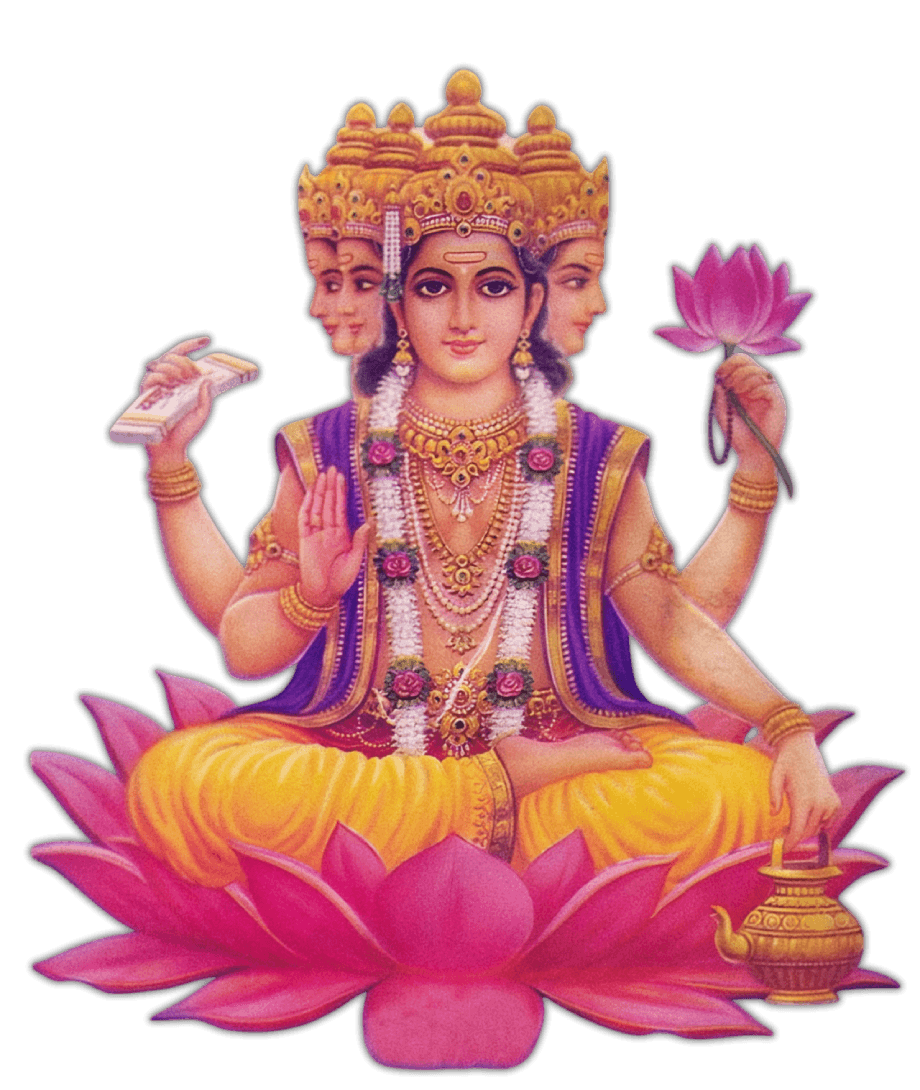
चतुर्मुख (Chaturmukha)
Four faces represent the Panch Mahabhutas: Fire, Air, Water, Sky, and Earth. Also symbolize four Vedas and four directions.
चतुर्भुज (Chaturbhuj)
Four arms holding the Vedas (knowledge), Kamaṇḍalu (cosmic waters), Rudrākṣa mālā (time), and Padma (lotus).
हंसवाहन (Haṃsavāhana)
Swan (Haṃsa) symbolizes supreme wisdom, discrimination between real and unreal, and transcendent consciousness.
स्वर्णवर्ण (Svarṇavarṇa)
Golden complexion represents the luminous Hiraṇyagarbha - the radiant, imperishable nature of supreme consciousness.
पद्मासन (Padmāsana)
Lotus seat symbolizes purity emerging from cosmic waters, creation arising from consciousness untouched by ignorance.
पितामह (Pitāmaha)
Matured appearance symbolizes ancient wisdom, eternal existence, and his status as the grandfather of all creation.
Sacred Texts
पवित्र ग्रंथ
महर्षिव्यास कृता श्री ब्रह्मा स्तुतिः (वायुपुराण अंतर्गत)
Maharshi Vyas krit Shri Brahma Stuti (From Vayu Purana)
A hymn to Lord Brahma from the opening chapter of the Vayu Purana, composed by Maharshi Vyasa, who bows to Brahma as the
रुद्र (महादेव) कृत श्री ब्रह्मा कवचम् (पद्मपुराण अंतर्गत)
Rudra (Mahadev) krit Shri Brahma Kavacham (From Padma Purana)
The Rudra-krit Brahma Kavacham, preserved in the Srishti Khanda of the Padma Purana, is a protective hymn in which Lord
श्री ब्रह्मा अष्टोत्तर शतनामावली
Shri Brahma Ashtottar Namavali
The Shri Brahma Ashtottara Shatanamavali is a devotional litany of the one hundred and eight names of Lord Brahma, the C
श्री ब्रह्मस्तोत्र (श्री भागवत पुराण अंतर्गत)
Shri Brahma Stotram (From Bhagvata Purana)
The Shri Brahma Stotram, from the Seventh Skandha of the Shrimad Bhagavata Purana, is a hymn uttered by Hiranyakashipu i
श्री ब्रह्मा स्तुतिः (श्री माहेश्वरतन्त्रान्तर्गता)
Shri Brahma Stuti (From Maheshwar Tantra)
The Shri Brahma Stuti from the third chapter of the Maheshwar Tantra is a hymn in which the gods adore Lord Brahma as th
श्री विष्णुकृत श्री ब्रह्मा स्तव (पद्मपुराण अंतर्गत)
Shri Vishnu krit Shri Brahma Stava (From Padma Purana)
Shri Vishnu-krit Brahma Stava is a hymn from the Padma Purana (Srishti Khanda, Chapter 29) in which Lord Vishnu himself
श्री ब्रह्माजी के प्रति भक्ती के प्रभेद, रथयात्रा, कार्तिक पूर्णिमा पर दर्शन का माहात्म्य, तथा 108 नाम
Devotion towords Lord Brahma, Rath Yatra, Importance of Darshan on Kartika Purnima, and 108 Names
This chapter from the Prabhasa Khanda of the Skanda Purana records Lord Shiva's teaching to Parvati on devotion to Lord
देवाधिदेव ब्रह्माजी के मन्त्र-जपविधिः
Lord Brahma Mantra and Jap Vidhi
A sacred guide to the japa of Lord Brahma's mantras, preserved in the Bramharchana Paddhati. It encompasses the revitali
हिरण्यगर्भसूक्तम् (ऋग्वेद)
Hiranyagarbha Suktam (From Rigveda)
The Hiranyagarbha Suktam is a revered Vedic hymn that adores Hiranyagarbha, the golden cosmic source identified with Bra
देवाधिदेव श्री ब्रह्माजी की दैनिक पूजा-विधि
Lord Brahma's Daily Pooja Rituals & Vidhi
A complete, scripturally ordained procedure for the daily worship of Devadhidev Lord Brahma, guiding the worshipper step
नारद कृता श्री ब्रह्मा स्तुतिः (पद्मपुराण अंतर्गत)
Narada Krit Shri Brahma Stuti (From Padma Purana)
The Narada krit Shri Brahma Stuti, from the Srishti Khanda of the Padma Purana, is a hymn in which the celestial sage Na
श्री ब्रह्मस्तोत्रम् एवं पञ्चरत्नस्तोत्रं (महानिर्वाण तंत्रार्गत)
Shri Brahma Stotram evam Pancharatna Storam (From Mahanirvan Tantra)
Shri Brahma Stotram from the Mahanirvan Tantra, is hymn spoken by Lord Shiva to the Goddess Parvati in praise of Brahman
देवकृत ब्रह्म स्तोत्रम् (स्कंद पुराण अंतर्गत)
Devakrit Brahma Storam (From Skanda Purana)
The Brahma Stotram, from the Suta Samhita of the Skanda Purana, is a hymn of praise offered by the gods to Lord Brahma.
देवकृत श्री ब्रह्मस्तुतिः (कालिका पुराण अंतर्गत)
Devakrit Shri Brahma Stuti (In Kalika Purana)
A Brahma Stuti from the forty-second chapter of the Kalika Purana, sung collectively by the gods who, dispossessed and t
देवकृत श्री ब्रह्मस्तुतिः (मत्स्य पुराण अंतर्गत)
Devakrit Shri Brahma Stuti (From Matsya Purana)
The Deva-krita Brahma Stuti from the Matsya Purana is a philosophical hymn in which the gods praise Lord Brahma as Omkar
श्री ब्रह्म कवचं (महानिर्वाणतन्त्रान्तर्गता)
Shri Brahma Kavach (From Mahanirvan Tantra)
The Shri Brahma Kavacham from the Mahanirvana Tantra is a protective hymn (kavach) addressed to the formless, attributel
श्री ब्रह्म स्त्रोतम्
Shri Brahma Stotram
A devotional hymn of salutation to Lord Brahma as the eternal, non-dual Supreme - the self-luminous cause, refuge and su
श्री ब्रह्म सूक्तम्
Shri Brahma Suktam
The Shri Brahma Suktam, drawn from the Atharva Veda and the Taittiriya Brahmana, glorifies Brahman as the Supreme Being,
श्री गायत्री अष्टोत्तर शतनामावली
Shri Gayatri Ashtottar Shatnamavali
The Shri Gayatri Ashtottar Shatnamavali is a devotional litany of the one hundred and eight names of Goddess Gayatri, th
श्री गायत्री कवचम् (श्रीमद्वसिष्ठसंहितायां अंतर्गत)
Shri Gayatri Kavach (From Shrimad Vasishtha Sanhita)
The Shri Gayatri Kavacha from the Vasishtha Samhita is a protective armour (kavacha) of the Goddess Gayatri, the Mother
श्री गायत्री सहस्रनामस्तोत्रम्
Shri Gayatri Sahastranama Stotram
The Gāyatrī Sahasranāma Stotram is a sacred hymn that enumerates one thousand names of the Goddess Gayatri, the mother o
श्री गायत्री स्तोत्रम् (देवी भागवत पुराण अंतर्गत)
Shri Gayatri Stotram (From Devi Bhagvata Purana)
The Shri Gayatri Stotram from the Devi Bhagavata Puranais a hymn imparted by Bhagavan Narayana to the sage Narada in pra
श्री सरस्वती अष्टोत्तर शतनामावली
Shri Saraswati Ashtottarshat Namavali
The Shri Saraswati Ashtottarshat Namavali is one hundred and eight names of Goddess Saraswati, the deity of speech, lear
श्री सरस्वती गीतिः
Shri Saraswati Giti
Shri Saraswati Giti is a lyrical Sanskrit devotional song to the Goddess Saraswati, deity of speech and learning, drawn
श्री सरस्वती कवचम् (श्री ब्रह्मवैवर्त पुराण अंतर्गत)
Shri Saraswati Kavach (From Brahmavaivarta Purana)
The Shri Saraswati Kavach from the Prakriti Khanda of the Brahmavaivarta Purana is a protective armour-hymn addressed to
श्री सरस्वती स्तोत्र
Shri Saraswati Storam
The Shri Saraswati Stotram is a devotional hymn traditionally attributed to Lord Brahma in praise of his consort Saraswa
श्री ब्रह्मदेव स्तुतिः
Shri Brahmadev Stuti
Shri Brahmadev Stuti is a concise verse hymn dedicated to Lord Brahma.
Our Mission
हमारा उद्देश्य
This website is dedicated to preserving and sharing authentic knowledge of Lord Brahma - his stotras, mantras, and scriptural references drawn directly from the Vedas, Puranas, and Itihasas, offered with faithful translations for seekers everywhere.
The Vedas and Upanishads still bear witness to Brahma's true identity as the Personified Brahman, the Supreme Creator, and the Eternal Source of all existence - a devotion this site seeks to restore in his own, original words.